
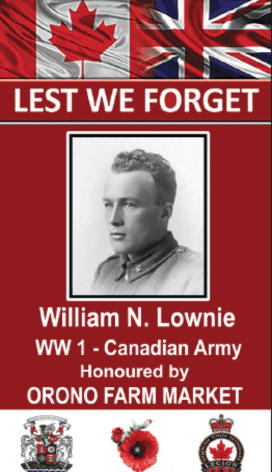
William Nicholson Lownie, was born on October 6, 1892 to William and Annie Lownie. When Lownie was still very young, the family emigrated to Canada from Scotland, where the family took up farming on a property east of Orono.
Prior to enlisting, he was a member of the 46th Militia Regiment. He enlisted in Port Hope in December, 1915, and was assigned to the 136th Overseas Battalion, Canadian Expeditionary Force. This training was undertaken first in Port Hope, continuing at Camp Barriefield near Kingston, and then at Camp Valcartier near Quebec City. On September 25, 1916 the unit sailed for England, before departing however, he married Elizabeth Lownie. Together they had one son, whom Lownie never had the chance to meet.
Upon arriving in England, the 136th Battalion was merged with the 39th Depot Battalion and the unit undertook further training prior to being moved to the front. On December 5, 1916 he was assigned to the 87th Battalion Infantry, CEF, known as the Canadian Grenadier Guards, and was placed in the field on December 11.
In early 1917, training began in anticipation of the assault on Vimy Ridge and by April 9, the attack was underway. Lownie’s battalion was in the first wave, tasked with capturing the highest section of the bridge. The battalion suffered numerous casualties during the assault, but Lownie survived. On October 28, 1917, at Passchendaele, Belgium, Lownie suffered a serious gunshot wound to his left back and shoulder. Just one short month later, after undergoing treatment in Rouen, France, he was returned to his unit.
By late March 1917, the allied forces had repelled a major German counterattack, and had turned the tides of the war. Near the town of Arras, France, on March 27, Lownie was once again seriously wounded. This time his injuries necessitated the amputation of both legs. Unable to survive the shock of extensive blood loss, he succumbed to his injuries on March 30, 1918.
William Nicholson Lownie’s body rests in the Houchin British Cemetery in Pas-de- Calais, France. His name is inscribed on the gates of the Orono Cemetery and on the Orono Cenotaph.
Courtesy of the Orono Weekly Times with special credit to Carol-Ann Oster
To subscribe to the Orono Weekly Times, please visit: https://www.oronoweeklytimes.com/