
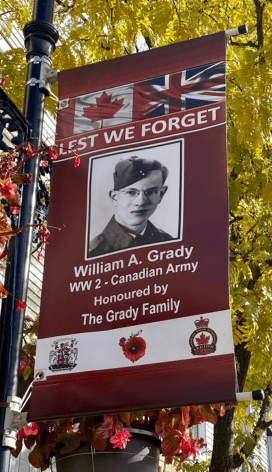
William (Bill) Grady was born on April 11, 1920 in Hamilton, Ontario to Earle and Mary Grady (nee Armstong). Mary had been a nurse and Earle was a supervisor at Stelco Steel. Mary’s mother, Mary CG Armstrong, and Annie Best – started the original Armstong’s grocery store in Orono. Earle, who was originally from Alberta, had met Mary while surveying for the rail line that would come through Orono. The two married and settled in Hamilton where they would raise seven children but the family’s connection to Orono had been forged. Bill was the third child in a family of four boys and three girls. He was raised and went to school in Hamilton, but he and his siblings spent a good deal of holiday time and summers at their grandparent’s home in Orono with their many cousins. His older brother John moved to Orono at 13 years of age after his grandfather died to help his grandmother run the grocery store.
In March of 1942, Bill followed his older brother enlisting for service in WW2. His first choice was the RCAF like his brother but changed this for service in the Canadian Army. Bill never talked much about what he did when in service, but it is known that he was assigned to the Royal Canadian Engineers. The mission of the Canadian Military Engineers is to contribute to the survival, mobility, and combat effectiveness of the Canadian Armed Forces. Their roles are to conduct combat operations encompassing the use of demolitions and land mines, the design, construction and maintenance of defensive works and fortifications, urban operations (hostile room entry), breaching obstacles, establishing/maintaining lines of communication, and bridging. In total, there are approximately sixteen specialties performed by engineering personnel. They were divided into field companies supporting various front-line infantry and armoured brigades. We do know that part of his responsibilities was inspecting damaged or captured enemy artillery, examining for weaknesses in design and other vulnerabilities.
Bill trained in Kingston, Ontario and from there transported to Britain. After leaving Halifax he said it took two weeks to travel to England only being allowed up on deck at night. He probably went ashore in France D-Day minus 2 with a field company seeing action as part of the 2nd Canadian Division fighting in Northwest Europe until the end of the conflict in May of 1945. He and his brother John would take their leaves together and travel to Scotland for salmon fishing. Somewhere in France, he was severely injured when a bomb hit a jeep he was traveling in, leaving him deaf with two fractured legs. He convalesced at a facility in Northern Ireland. He was decommissioned in December of 1945, travelling home on the Queen Mary to New York City and then by train to Toronto. The legs would heal but the deafness would remain with him.
Upon returning, Bill and his younger brother Harry, a WW2 Canadian Navy veteran, looked after one of their grandparent’s orchards on the 6th Concession north of Orono. In 1947 he married Ruth Goode of Orono. The pair would raise four children in the north end. He was employed with General Motors, working for a period of twenty-five years as a supervisor at the truck plant. Upon retirement he became a real estate agent for four or five years. He volunteered his time on the Orono Town Hall Historical Board. He is described as a quiet man, partly due to the profound effects of his deafness. Nevertheless, he was always helping others and noted for a wicked sense of humour.
William died on June 27, 1999 at 79 years of age.
Courtesy of the Orono Weekly Times with special credit to Kerry Grady and
Kathryn Clarke
To subscribe to the Orono Weekly Times, please visit: https://www.oronoweeklytimes.com/