
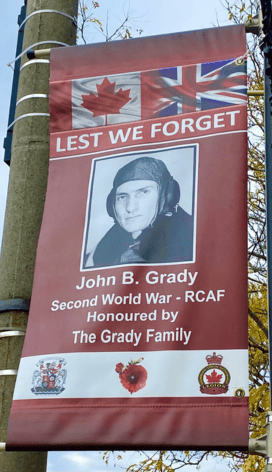
Orono’s secret hero, John Bruce Grady was born and raised in Hamilton, ON, the second oldest of seven children. At the age of 13 following the death of his maternal grandfather, he left his family home and moved to Orono to live with his grandmother. Here he helped run the Armstrong family general store.
He soon became well known around town as he delivered groceries, and over the years became a popular figure around Orono. When the war came in 1939, John enlisted with the RCAF, and was eventually stationed in England. His earlier dreams to attend medical school were put on hold.
In August 1944, a telegram was delivered to the home of John’s parents in Hamilton, stating that John had not returned from a mission and was assumed to have crashed. The family knew little of what happened to John Grady, other than he had been shot down over France. There was however, much more to this story that would only come to light many years later.
John worked as a navigator, based out of Tempsford Airfield in Bedfordshire, England, and was a member of one of two Moonlight Squadrons, a top secret ops mission of the British Air Force. This information remained secret until documents detailing their work were declassified in 1998. Having signed an oath under Britain’s Official Secrets Acts, his heavily censored letters home never hinted at the work John was doing.
The Moonlight Squadrons, were also known as “Churchill’s Secret Army”. Flying black painted, British Royal Air Force Halifax bombers, these squadrons helped collect vital and covert information that led to some of the war’s biggest victories, and aided a network of resistance movements across Europe.
Their missions involved dropping secret agents, weapons, and much needed supplies from ammunition to clothes, to typewriter ribbon. The squadron flew primarily on moonlit nights, guided only by local landmarks, flying low to the ground to avoid radar detection, and landings were often guided into remote fields with only the smallest of lights. They stayed on the ground only for the briefest amounts of time needed to drop supplies, and on occasion picking up downed Allied airmen, helping them escape capture and make their way safely but secretly back to England.
In the overnight hours of August 8 – 9, 1944 John and his crew took off for what would be their final mission. Southeast of Paris, their Halifax was spotted and hit by enemy fire. Their cargo that night was arms and explosives, and as a result once hit the plane exploded, crashing and burning in a field in Cugny.
Villagers immediately arrived at the crash site and pulled the remains of the crew from the wreckage. Though Nazi occupiers forbade it, the villagers are believed to have held a small funeral and buried the remains of the seven in their village cemetery, in the grave of an unknown soldier of the First World War.
So grateful were the citizens of Cugny for the assistance and bravery of these men, following the war they sought permission from Queen Elizabeth to have a permanent memorial erected at the crash site. Permission was granted and the monument remains to this day with the names of all seven crew members engraved upon it.
The people of Orono mourned John’s death, remembering him as a kind and gentle person, unaware of the heroic work that he completed during the war. He is remembered at home on the Orono Cenotaph.
John was twenty-six when he died.
Courtesy of the Orono Weekly Times with special credit to Carol-Ann Oster
To subscribe to the Orono Weekly Times, please visit: https://www.oronoweeklytimes.com/