
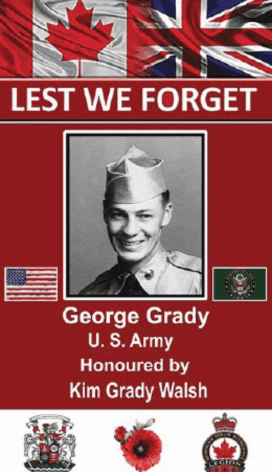
Charles George Grady, known as George to all, was born on March 1, 1929 in Hamilton, Ontario. He was one of seven children born to John Earle and Mary Lulu Grady. Mary had been a nurse and Earle was a supervisor at Stelco Steel. Mary’s maiden name was Armstrong and her parents were the original proprietors that opened the original Armstrong’s grocery store in Orono. Although George’s parents had settled in Hamilton to raise their family, the family’s connection to Orono was strong. George was raised and went to school in Hamilton, but he and his siblings spent a good deal of holiday time and summers at their grandparent’s home in Orono with their many cousins. All four Grady brothers had worked in their grandparent’s grocery store. After the death of his father, George’s mother returned to Orono to live with her sister. That house became a common gathering spot for her grown children and numerous grandchildren to spend time together.
During WWII, three of his brothers enlisted and served with the Canadian forces, his oldest brother John killed in action. Of course, George was far too young to have joined the conflict. After completing high school, in about 1950 George enrolled at Ryerson Institute of Technology in Toronto, completing a course in electrical engineering. On October 3, 1953, George married his childhood sweetheart from Hamilton, Valerie Ann Lounsbury. The pair of them picked up stakes and left for the United States.
George enlisted with the U.S. Army in late 1953. He was assigned to Fort Dix near Trenton, New Jersey. This base is a huge military complex that was established as a readiness centre and jumping off point for troops crossing the Atlantic to war or staffing U.S. bases in Europe. It was also a basic training centre for infantry personnel. The newlyweds would have moved into temporary housing on base. In total, George spent two years serving at Fort Dix, at that time the home base for the 9th Infantry Division, U.S. Army, where he was involved in training recruits and reservists. Infantry tactics had dramatically changed after WWII, the “foot soldier” now had to be taught the new battlefield realities, mechanization, infantry fighting vehicles, amphibious seaborne assaults, airborne assaults, communications, etc.
In 1955, possibly with the assistance of the G.I. Bill, George attended the University of Missouri, Science & Technology at Rollo, Missouri. He took mining and engineering courses, graduating as a metallurgical engineer. This is a type of materials engineer who specializes in the development, processing, and testing of metals. They often work in the industrial sector for manufacturing firms, foundries, mining companies and scientific organizations. George found employment in a number of foundries, first at Dunkirk, New York which is outside of Buffalo. In 1961 he moved on to a foundry in Latrobe, Pennsylvania, and in 1966 to another in Warren, Pennsylvania. The year 1968 saw a move to Ligonier, Pennsylvania where he worked as a consultant for a New York City based firm. He worked for them until retirement in 1985, prompted early by rheumatoid arthritis.
George and Valerie had raised a family of three, two daughters and a son. In retirement they settled in Cranberry, Pennsylvania, just outside of Pittsburgh. He was an avid golfer and they spent time on a property they owned in Florida. George passed away in 2004 at the age of 76 years. His three children describe him as the best Dad ever.
Courtesy of the Orono Weekly Times with special credit to Carol-Ann Oster
To subscribe to the Orono Weekly Times, please visit: https://www.oronoweeklytimes.com/