
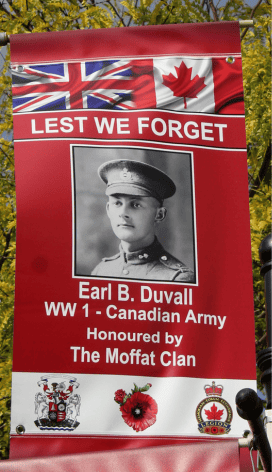
Earl Beamer Duvall was born in Grimsby, Ontario to John and Augusta Duvall. He was educated in the local elementary and high schools before continuing his education at the Hamilton Business College. Following completion of his studies, he went to work as an electrician for the Dominion Power and Transmission Company of Hamilton.
Aged 25 years old, Earl reported to the 1st Depot Battalion, 2nd Central Regiment in Hamilton, on October 17, 1917, where he underwent his medical exam. He was later attested in Hamilton on May 20, 1918, and from there posted to the Canadian Engineers at the military base of Saint-Jean-sur- Richelieu, in Quebec. It was here that he underwent training as a signaler. In Ottawa, on January 3, 1919, Earl was taken on strength with the No. 6 Signal Company, Canadian Expeditionary Forces, and in quick succession was promoted to Corporal.
Canada at the time was held in high esteem for their work in signalling. The first military signal unit was created in 1903. With the advent of wireline and wireless communications, these specialists carried out the important work of maintaining and securing communications to their own units, and at times intercepting those of their enemies.
Earl was transported to Victoria, British Columbia, and from there embarked for Russia on February 12, 1919, arriving in the Siberian port city of Vladivostok.
It is not widely realized that the Canadian military were present in Russia following the 1917 Bolshevik Revolution. The revolution had deposed the Czar, with the Bolsheviks seizing power in St. Petersburg and Moscow. Much of the country remained under the control of the White Army which supported the Russian Empire under the Czarist regime. Troops from Canada, along with those from Britain, the United States, and Japan were present to support the White Russians. Approximately 4,200 troops were provided by Canada, with most stationed in Vladivostok where they undertook routine drills and policing duties across the city. Canadian troops were not involved in fighting action, and after a brief period our government opted to draw down its involvement, recalling all troops by June, 1919.
Earl was returned to the 2nd District Depot in Vancouver on April 23, 1919, before being discharged from service on May 15, in Hamilton. Upon his return home to Grimsby, he married Mona Miller. Together they had two sons, and in 1936 the family took up residence in Leskard, where Earl opened a general store. He retired in the early 1960’s but remained activity within his community, serving as a member of the Orono Masonic Lodge, the local Church Board, and the School Board.
Earl passed away on January 21, 1972 at the age of 80 years old.
Courtesy of the Orono Weekly Times with special credit to Carol-Ann Oster
To subscribe to the Orono Weekly Times, please visit: https://www.oronoweeklytimes.com/